Liner Notes: Trevor Diacono on Rust, Paradox and the Sea He Misses
Updated: Oct 15

Liner Notes is a series of conversations with the people making Malta's creative scene. We begin with Trevor Diacono, who left the island for Brussels and now works there in iron, copper, epoxy and cement. Etienne Licari called him on a Wednesday afternoon with twelve questions written down. They got through most of them, and the best parts were the bits in between.
In short: Trevor Diacono is a Maltese mixed-media sculptor based in Brussels, working in iron, copper, epoxy and cement. He runs ten to twelve hours a day across six commissions and his own pieces, took a humbling year to sell anything after moving abroad, and thinks the Maltese art scene is routinely underestimated. A solo show at Kamra ta' Fuq is booked for February 2027, and a five-room exhibition for February 2028.
Making the vessel
EL: For someone standing in front of your work for the first time — what are they looking at, and what do you hope happens to them?
TD: I work in different styles because each idea needs its own way of being expressed. I work across different materials and processes, and although humour and paradox often appear in my work, not every piece necessarily has them. I think the consistent thread is more about the juxtaposition of bringing different or sometimes contrasting elements together.
EL: Is there a specific message you're trying to convey, or are you putting them in a stop-and-think moment so they make of it what they want?
TD: I don't think it's my job to tell people exactly what they should see or feel. My job is to create the journey, almost like a vessel that allows them to arrive at their own reflection or interpretation.
Twelve hours, six commissions, one messy studio
EL: Your medium and your method. What does a working day in the Brussels studio actually look like?
TD: I enjoy working with different materials because each one has its own strengths and limitations. My work is quite varied, and I tend to move between different ideas, materials and processes rather than working in just one particular style.
TD: At the moment I'm working with materials including iron, copper, epoxy and cement, among others. I also have six commissions in progress right now, which are completely different from the Iron Ladies I'm currently developing. I like keeping things diverse because different ideas often demand different materials and approaches.
TD: A normal day starts after I take my daughter to school. Then I'm usually in the studio for ten to twelve hours. Because different sculptures involve different stages, drying times and processes, I tend to have several pieces going at once and move between them throughout the day.
EL: Twelve hours is a long stretch. Is there a shape to it — a ritual that gets you into the work, or do you walk in and pick up where you left off?
TD: My studio can be a complete mess. But my new studio will have big windows onto the street, and I'm hoping the idea of people looking in will make me keep it tidier.
EL: So you're going to graduate from an artist to a performing artist.
TD: I like the idea of people stopping, looking in, and engaging with what I do.
Music, walking, and where the ideas come from
EL: What's playing while you work? And do you get inspiration from it, or do you use it to find inspiration?
TD: I usually have music or a podcast playing while I work. Sometimes it's old-school hip hop, sometimes a podcast, and sometimes something completely different. There have been times when a particular song has influenced a sculpture, but I haven't really worked that way in the past few years.
TD: Sometimes I'll even listen to a podcast in a foreign language, or something very scientific, because I don't necessarily want to follow every word. It's more like having a companion in the studio, or something in the background that occasionally catches my attention.
EL: So where does the inspiration actually come from?
TD: Most of my inspiration comes from observing people and the world around me. I'm interested in people in motion, but not necessarily just locomotion. I like to observe facial features and expressions, the energy of busy life and the quieter, slower moments too. Nature is another important source of inspiration, and sometimes an idea will simply come to me while I'm walking.
EL: Do you interact with technology to get inspiration?
TD: Technology plays a part too. I use AI as a tool to explore and develop ideas, sometimes to compare different possibilities or push an initial concept further. I use Procreate to experiment over photographs of my sculptures, and Nomad Sculpt on the iPad to develop and test forms digitally before taking them further physically. Nowadays we have access to so many useful tools, and for me it's important to explore whatever helps me develop an idea.
Brussels, and the year of being nobody
EL: Why Brussels? What does that city give a Maltese artist that the island couldn't — and what does it cost?
TD: Brussels is a great place for an artist because it has such a strong and active art scene. There are exhibitions happening all the time and plenty of opportunities to discover new work and meet people. You can walk through parts of the city and move from one gallery to another.
TD: There's also the geographical advantage. Brussels is at the centre of Europe, so France, the Netherlands and Germany are all easily accessible. That makes logistics easier too, especially when you're working with sculpture. The pieces can be heavy, and transporting them is often more complicated than transporting paintings.
TD: In Malta I already had an established base of collectors and clients, and I continue exhibiting there because I don't want to lose that connection. But being in Brussels also gave me the opportunity to build an entirely new audience.
EL: Was it not intimidating to move somewhere nobody knows you?
TD: Moving here humbled me. I probably arrived a little overconfident, and I was humbled very quickly. I discovered how difficult it could be just to get a gallery to reply to an email. In Malta I already had relationships with galleries and people knew who I was, so it was easier to take the next step. Here, I was a complete stranger.
TD: I think the naivety helped me take the plunge. It took around a year before I made my first sales here, but thankfully those first collectors became repeat collectors, introduced friends to my work, and gradually things started to ripple out from there.
EL: And the trade-offs of being away?
TD: The downside is that when you're living abroad, you're more detached from what's happening back home. People don't necessarily think of you immediately when a commission comes up, so you have to make a conscious effort to maintain that connection and remind people that you're still there and still working. I've even had to refuse some larger commissions because producing and transporting them from Brussels to Malta simply wasn't practical.
EL: And outside of work? What else do you feel you've given up?
TD: I miss the nature of Malta. I feel that absence quite strongly. And I miss my friends, of course. I miss the whole atmosphere and way of life.
TD: In Malta my friends would call me and say, “Come and watch the sunset,” and I'd feel guilty sitting in a hot studio while everyone else was at the beach. Here, when it's raining outside, it's much easier to think: I might as well stay in the studio and work. I can definitely become more of a hermit within this lifestyle.
TD: Whenever I go back to Malta, it's the beach every single day. Even in December. The Mediterranean, in my humble opinion, is the most beautiful sea in the world. That blue.
TD: I also miss the colours of Malta, those oranges and yellows. Sometimes I take a train or drive a couple of hours to the coast here, but it's not the same. You've got the sand dunes, but you don't have that blue.
TD: But at the same time, we have these incredible forests here. The forest begins just behind my house, and I take my daughter there almost every day. Sometimes we walk through it when it's covered in mist, and it's beautiful. I don't take that for granted, the beauty of having all that green around me. Every place has its own kind of beauty.
Malta from a thousand miles
EL: Does distance sharpen the island in your work, or dissolve it?
TD: That's a difficult question, because I think both things happen. Distance can sharpen your connection to a place because it creates nostalgia. I hold a deep nostalgia for the beauty of the Malta I remember.
TD: It's a bit like looking back on an old relationship — you remember everything as being magical.
TD: At the same time, with everything that's been happening and the negative news coming out of Malta, there are moments when I'm also grateful to have a little separation from it all.
EL: Exhibiting abroad versus showing in Malta — how differently do the two audiences read the same piece?
TD: The biggest differences I've experienced aren't necessarily in the way people interpret the work, but in the practical side of exhibiting. Things tend to be more structured here. In Malta there's sometimes more flexibility and a more informal approach, whereas here there can be more procedures around things like insurance and logistics.
TD: But when it comes to the audience and collectors, I honestly don't think there's as much difference as people might expect. The Maltese art scene is very sophisticated and I think sometimes people underestimate it.
TD: The collectors in Malta are every bit as culturally engaged and knowledgeable as the collectors I've encountered here. When I speak to collectors about why a particular piece resonates with them, the conversations are often very similar.
Seven Iron Ladies, and one that missed its flight

EL: What's on the bench right now, and what's the itch behind it?
TD: At the moment I'm working on a wide range of different pieces. I have six commissions underway, using completely different materials and approaches, alongside my own independent work.
TD: One of the projects I'm currently developing is a series of Iron Ladies. I want there to be seven of them, each around eighty centimetres tall. I'm working with iron and developing the surfaces as an important part of the work. I'm also experimenting with a few iron pomegranates incorporating faces.
TD: With the Iron Ladies I'm enjoying moving further into abstraction rather than trying to reproduce faces too literally, making the forms more fragmented and allowing the surfaces to become an important part of the final work. What fascinates me about these particular pieces is the transformation of the material over time. I enjoy watching those changes become part of the finished work, and then preserving the final surface.
TD: The title “Iron Lady” inevitably brings Margaret Thatcher to mind. Iron suggests strength and permanence, but even iron can deteriorate and change. That's the contradiction I like exploring — the idea that something which appears strong and impenetrable will still be broken down over time.
EL: And the piece that didn't make it to Malta?
TD: Unfortunately one sculpture couldn't make it to an exhibition in Malta. I wasn't allowed to take it through Charleroi Airport as hand luggage because of its dimensions, so I had to bring it back home again. Thankfully this has now been rectified and the work is currently being exhibited.
What the island leaves in the work
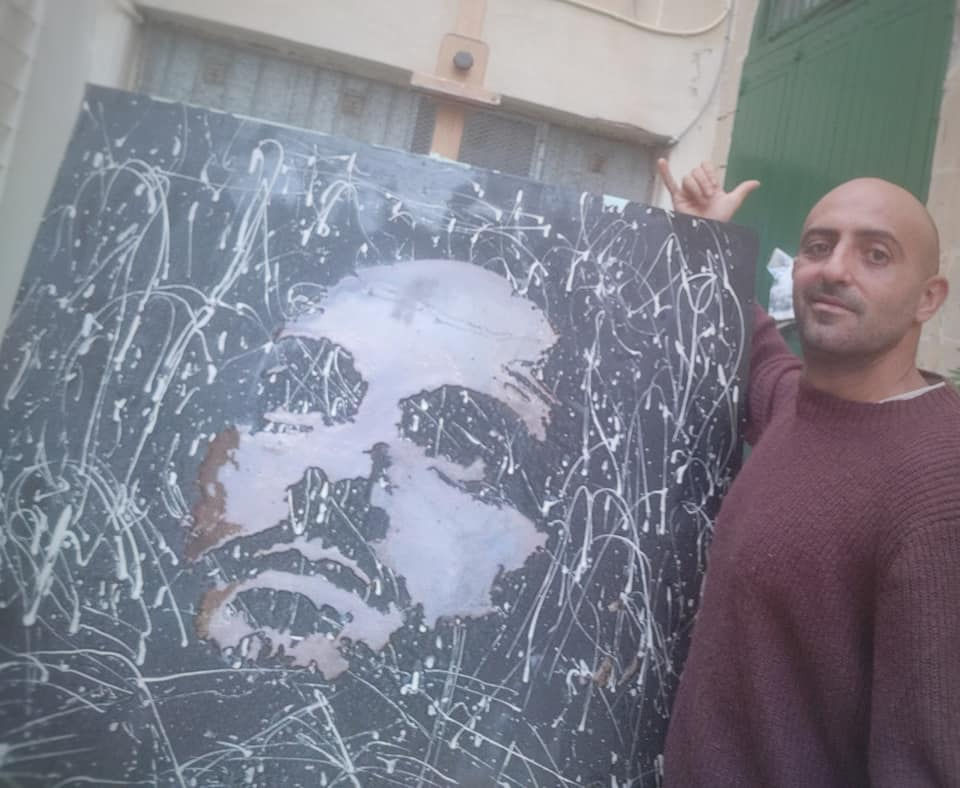
EL: Malta's light, limestone, density, sea — which of the island's textures follow you into the studio uninvited?
TD: Whenever I think about relaxation, harmony and colour, my mind naturally goes back to Malta. Those colours are already in me; they're part of my visual vocabulary.
TD: The sunsets, those explosions of colour. Even people's clothing and skin tones influence the palette and tones I instinctively return to. It's not something I choose consciously. It's just there, already a part of me.
EL: What's the piece you're proudest of, and what did it take out of you?
TD: For me the sense of pride often comes from how closely the finished sculpture matches what I originally imagined. It's never going to be exactly the same, but sometimes a piece comes closer to what I had in my mind. Other times the sculpture takes a completely different direction and surprises me, and that can be just as rewarding.
TD: Every sculpture creates a different feeling. It's a little like creating a baby and then sending it out into the world. I don't really have one piece that I hold above all the others.
EL: And how do you know when to stop?
TD: Sometimes you only realise you've gone too far once you've actually gone too far. That's when you know you've passed the point where it was working, and you need to take a step back.
Who else should the world know?
EL: When you're abroad, how much do people actually know about Maltese art? And who should the world know about that it doesn't yet?
TD: Malta has a rich artistic scene, and there are many artists doing interesting work. My grandfather, Victor Diacono, was also an artist, and was one of the artists who helped bring modernism to Malta after the Second World War. He went to Rome on a scholarship and later returned to Malta.
TD: As for naming contemporary artists, I'd prefer not to single anyone out. There are too many artists I admire, and I wouldn't want to unintentionally leave out or offend people I know.
A sculpture park on the seabed

EL: What would a healthier art market and gallery scene in Malta look like?
TD: I'm not sure I'd necessarily say it needs to be healthier, because I actually think the scene is quite healthy. There always seems to be something happening — new exhibitions, artists showing work, commissions coming through.
TD: What I would like to see more of are opportunities for artists to create work for public spaces: open calls for installations, sculptures and projects that become part of the urban landscape. Those opportunities exist, but they don't come around often enough.
EL: What would you like to see happen with public art in Malta?
TD: You know what would be really cool? An underwater sculpture park around Malta, something accessible enough for snorkellers to explore. Not thirty metres down, but something closer to ten metres, where people could actually experience it. And it shouldn't belong to just one artist. It could begin with a group of Maltese artists and continue growing over time.
TD: Obviously something like that would need to be approached responsibly, with proper environmental assessments and consultation. It's not something you could simply place in the sea without considering the impact. But if it could be done responsibly, I think it could be something really special for Malta.
Hotels, garages, and rooms full of art
EL: What would it take for you to double the number of times you show in Malta?
TD: I'm already working close to my maximum capacity. At the moment I have several commissions and personal projects happening simultaneously, often using completely different materials and approaches. Every sculpture is unique, so increasing production isn't simply a matter of repeating the same thing.
TD: I've booked a solo exhibition at Kamra ta' Fuq for February 2027, and I'm also preparing for a much larger exhibition in February 2028. That one will occupy five large rooms and require a significant number of pieces, which is why it has been planned so far in advance. There's a lot of thinking and preparation behind it.
EL: And you'd still choose an international expo over a show in Malta?
TD: For me international exhibitions are partly about putting my work into a wider context. They strengthen my portfolio, but they also create opportunities. You never know who might see the work — a curator, collector or gallery from somewhere else.
EL: Could hotels and unconventional spaces become places for art?
TD: I recently saw an interesting example of a hotel that was about to open where each room was associated with a different artist. People could experience the work while staying there, and the project generated a lot of interest.
TD: Hotels can be interesting spaces for art because the audience is already there. The people staying in them are often travelling, discovering new places and potentially interested in collecting. If artists bring their own following as well, it can create a wider network of people discovering the work.
TD: There are also interesting alternative spaces. There's a place in St Julian's that's actually in a garage, but they've turned it into a gallery. They organise parties with DJs and music and have shown some really interesting artists there. Even a one-off pop-up can work. It doesn't always have to be permanent.
EL: What would you make next if collectors, galleries and rent didn't exist?
TD: I'd go absolutely huge. I'd love an enormous warehouse with no columns or restrictions — just a huge open space where I could create massive, human-scale or even larger works.
TD: I love that people collect my work and live with it, but if money and practical limitations didn't exist I'd also love to make work that belonged to a wider public. The idea of creating something that thousands of people could encounter and reflect on is very exciting to me — large-scale public work that people can simply encounter in their everyday lives, outside a traditional gallery or private home.
The record for the shelf
Every Liner Notes interview ends the same way, because this is a house named after a singer.
EL: Your record for the shelf — what plays in the studio when the work is going well?
TD: It really depends on the mood. Most of the time old-school hip hop is probably my go-to, but I'll also listen to Bob Marley or even minimal techno. It can be very different depending on the vibe.
EL: And who should we interview next?
TD: Nikki — the didgeridoo player from Tribali. He's a really interesting guy and has plenty of stories from his travels. I'd vote for Nikki.
Consider it arranged.
Trevor Diacono works in Brussels. See the work at trevordiacono.com and @trevordiacono on Instagram.
Frequently asked questions
Who is Trevor Diacono?
A Maltese sculptor based in Brussels, working in mixed media — iron, copper, epoxy and cement. His grandfather, Victor Diacono, was among the artists who brought modernism to Malta after the Second World War. Solo exhibitions in Malta are booked for February 2027, at Kamra ta' Fuq, and February 2028.
What is Trevor Diacono working on now?
A series of seven Iron Ladies, each around eighty centimetres tall, worked in iron with the surface treated as part of the piece, plus iron pomegranates incorporating faces. Alongside them he has six commissions in progress, in completely different materials, and he moves between several pieces a day because of drying times.
Are Maltese art collectors as sophisticated as European ones?
Trevor's answer is that the gap is smaller than people expect. He says the Maltese art scene is very sophisticated and often underestimated, and that collectors in Malta are every bit as culturally engaged as the ones he meets in Brussels.
Liner Notes is published from Morrison Court, five self-contained apartments in a reimagined 1920s townhouse in Gzira, with record art on the walls and a turntable on request. Next in the series: a musician. morrisoncourt.com.